

Fisheries and port facilities
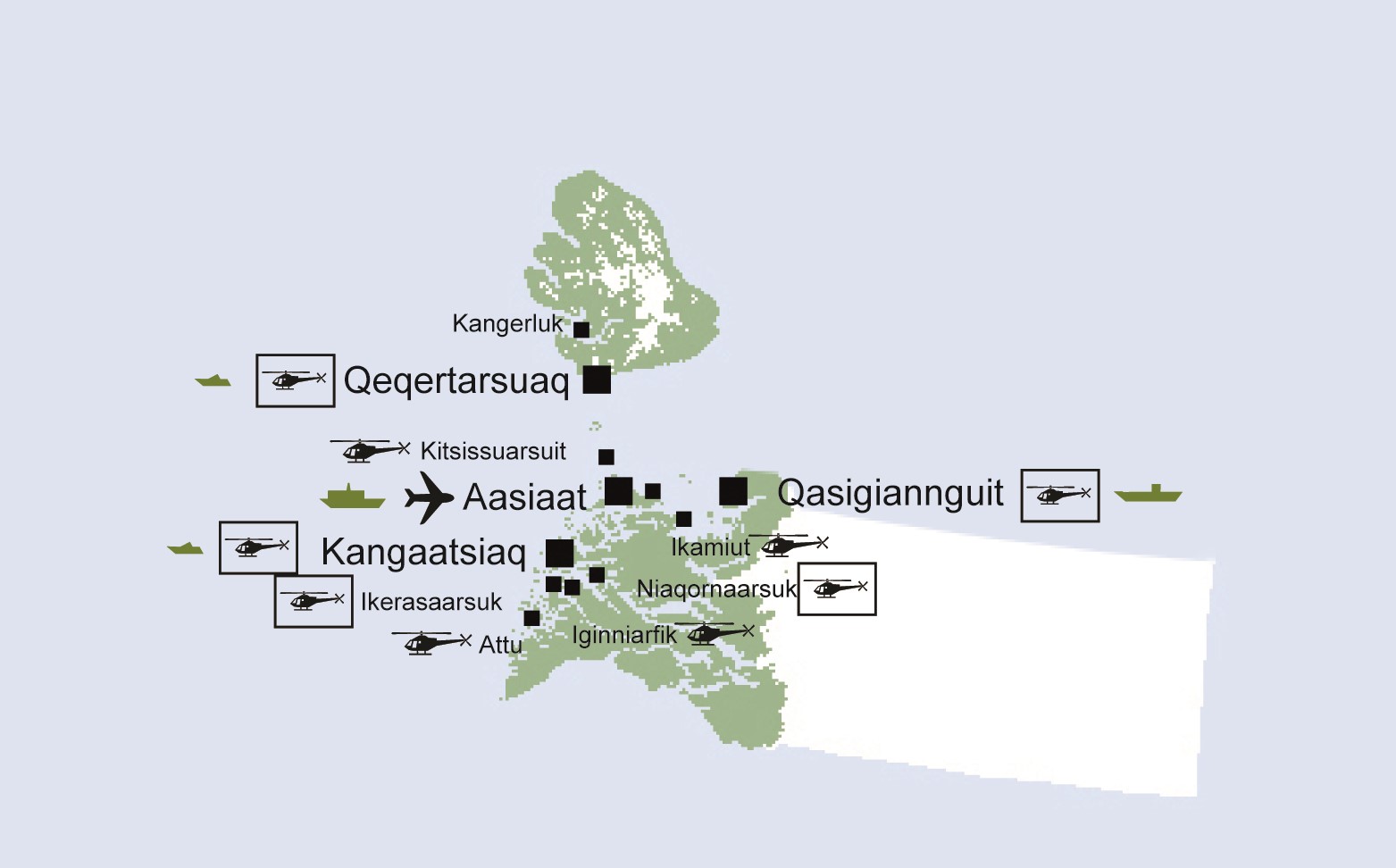
All ports and ports of call in the municipality are owned and operated by the Self-Government. The facilities play a central role in Greenlandic society, as primary industries such as fishing and tourism, as well as the transport of goods, are completely dependent on them. The ports vary greatly in size and function and include 3 main types: Ports with Atlantic traffic, ports with feeder traffic and ports with only rural traffic.
Ports and maritime transport constitute a key component of freight transport both internationally and domestically. Both types of freight transport are operated by Royal Arctic Line A/S. Outbound freight from Greenland consists predominantly of fish products, whereas inbound freight primarily comprises materials for the construction and civil engineering sector as well as consumer goods. Since 2009, however, freight volumes have declined significantly as a consequence of the global economic crisis.
Fisheries – in particular shrimp, Greenland halibut and crab – remain the principal industry and are of decisive importance to the Greenlandic economy. This also applies to the Municipality of Qeqertalik, which covers a substantial part of the west coast of Greenland and accommodates the vast majority of the fish processing industry’s factories and landing facilities. In recent years, however, declining prices on the global market have placed the fisheries sector under pressure. This has necessitated both an increase in catch volumes and the implementation of general structural adjustments, including changes affecting associated processing facilities. As the largest operator, Royal Greenland has undertaken a process of centralization through mergers and closures of production plants and landing sites. Today, Royal Greenland operates four factories and 4 landing facilities distributed across the municipality.
The changes in the fishing industry and the general slowdown since 2000 are clearly visible, especially when looking at the population and employment in the settlements, where many procurement sites have closed.
In order to be able to meet the growing global competition and the effects of climate change in Greenlandic waters in the future, major investments are required in the fishing industry. The investments are related to both the continued modernization of the fleet of fishing vessels itself, but equally to more and improved port facilities, including more procurement facilities.
Last but not least, the ports play an important role in passenger transport and cruise tourism. Sailing activities vary somewhat throughout the year depending on ice conditions, with primary activity in the summer months. The main operators within passenger traffic are Arctic Umiaq Line, Disko Line and Royal Arctic Bygdeservice, all of which operate in the Municipality of Qeqertalik. However, climate change and increased focus on tourism are placing new demands on the sailing conditions, so that both more and larger ships – e.g. modern cruise ships – can dock, cf. the section on "Tourism", which is a focus area going forward that will help promote cruise tourism in the municipality.
In addition, the Government of Greenland has designated port authority areas, which must also be incorporated into the planning work in Municipality Qeqertalik.
Aviation
Aviation is a central element of Greenland's infrastructure and is used daily for the transportation of goods and passengers. The location of airports, heliports and helistops in Municipality Qeqertalik can be seen on the main structure map. The facilities are owned and operated by Mittarfeqarfiit. Aasiaat is served via the airport, while the other towns and settlements have either a heliport or helistop. All areas designated for aviation are subject to claused zones in terms of safety, visibility, obstacle-free plans, etc. Claused zones are binding in terms of the use of the areas, height restrictions and thus also future urban development.
The development of aviation infrastructure is generally an important part of the plans in order to exploit the potential of the municipality's cities – not least to promote tourism on the North Greenlandic west coast. In the three cities that are not currently served by fixed-wing aircraft – Kangaatsiaq, Qeqertarsuaq and Qasigiannguit – a location study for the location of airports will be carried out in the upcoming planning period.
The airport in Aasiaat is the only one in Municipality Qeqertalik. In the 2019 Finance Act, it has been decided that seven new regional runways will be established in Greenland. Three of these will be located in the new Municipality Qeqertalik in the towns of Kangaatsiaq, Qasigiannguit and Qeqertarsuaq. Therefore, site investigations must now be carried out with the aim of finding the best location for the future regional runways. This includes a study of earthworks, the flight technical conditions with climate, wind and turbulence, EIA studies and a societal impact assessment. In addition, both citizens and the municipality must be involved in the Naalakkersuisut site investigations. Here, the best location in relation to mountains, water and the subsoil is investigated. It is equally important to find the ideal location as close to the city as possible. The upcoming regional runways in the municipality will create a better connection between the three local towns and the capital city of Aasiaat, and thus also with the rest of Greenland. The new runways are necessary for commercial development in the cities, not least to promote tourism, and will make transportation between cities much cheaper.
Raw materials industry
Development opportunities within the raw materials industry include both hydrocarbons and minerals, where a large number of exploration activities have been underway. There have only been concrete extraction activities in the minerals area, and still only to a limited extent. In the oil and gas area, activities have so far been limited to exploration and preliminary studies west of Disko Island and in Baffin Bay.
A relatively new industry focused on the production of water from either springs or by tapping from floating icebergs. The water is used for the production of drinking water in bottles, beer, ice cubes, etc. In the Municipality of Qeqertalik there is, among other things, a production site in Qeqertarsuaq.
Tourism
Municipality Qeqertalik generally has a great potential in terms of tourism – probably the largest in all of Greenland. Therefore, tourism is an important key to ensuring an economically sustainable basis, which can partly support the livelihoods of the municipality's many towns and settlements, but which can also form the basis for future investments in Northwest Greenland. The areas around Disko Bay will continue to be a hub for the tourism industry in the region, including the starting point for many of the Arctic experiences and attractions – including sledding, cruises, whale watching, northern lights, hiking and village visits.
The development potential is large, but is closely linked to the supply, including the location and quality, of ports and airports, accommodation options, etc. A similar connection is seen in relation to the development of offshore-related industries, including in relation to the distribution and processing of raw materials and the recruitment of labor. The municipal plan includes a number of unused land plots, which could also form the necessary basis for the future development of the tourism industry.
One of the biggest changes during the planning period is the new and larger airport in Ilulissat, which will go from being a purely domestic airport to being able to receive large international flights. A change that will have a major positive impact on tourism for the entire Municipality of Qeqertalik, as well as for the neighboring municipality of Avannaata Kommunia with easier access to, among others, Disko Island and Aasiaat.
Climate change may mean that areas in the open countryside will generally become more accessible, and some ports will be navigable for larger parts of the year. There is therefore a growing interest in establishing tourist cabins and similar tourist facilities in attractive locations along the coast, e.g. in Disko Bay, where the municipal plan has demarcated new cabin and summer house areas – see the section "The open countryside".
Finally, the municipal plan includes a number of sled tracks, paths and hiking routes that support the tourism industry. The intention is to continuously expand and develop the trail network and hiking routes in the open countryside, and to secure the sled tracks.
Sled dogs play an important role in tourism. That is why the vast majority of towns and villages have open areas that are used as dog parks – in some places in the form of "dog islands". Going forward, emphasis will be placed on securing the existing parks, and in some place’s expansion opportunities will be found. In the upcoming planning period, a comprehensive dog and cat statute will be drawn up for the municipality, which will be incorporated into the municipal plan in terms of area.
Other professions
Municipality Qeqertalik's many commercial and port areas must - in addition to fishing-related functions and facilities - also accommodate many other types of businesses, e.g. small craft and service businesses, warehouses, transport companies and production. In the smaller towns and settlements, the areas are located on the coast, while the slightly larger towns have "pure" commercial areas elsewhere within the urban area. The commercial and port areas are typically subject to distance requirements in relation to noise and safety conditions for e.g. tank farms and certain types of storage.
Overall, there is a total of approximately 480 hectares of space for business in the municipality's towns and settlements. This is considered sufficient to cover the area requirement within the municipal plan's 12-year time horizon. The municipal plan therefore does not include new land allocations for business.
Road network
The municipality's road network is located exclusively in the cities and settlements and includes a network of primary traffic roads, secondary roads, local roads and other private roads, as well as lanes and paths in the city.
The intention is that the road network will be expanded in line with general urban development – including new residential and commercial areas and – not least – ports, airports and heliports, which are the backbone of Greenland’s infrastructure. In the long term, climate change may mean that it will be possible to build roads between some of the municipality’s closest towns and settlements, thereby strengthening the mobility of citizens. Investments in larger road projects, however, are handled by the Self-Government.
With the new Municipal Plan, the road structure in the municipality has been reviewed, with a particular focus on updating the road structure and road construction lines. This means upgrading as well as downgrading a number of roads in Municipality Qeqertalik. Some roads are being downgraded to create space for parking spaces, while others are being upgraded to improve accessibility. It must also be ensured that the lanes in towns and settlements are kept clear and of good quality.
Pedestrian conditions and Shared Space are also of great interest and a focus area in the planning period until 2030. Sidewalks and paths are being built along the roads and the path network is being expanded to strengthen pedestrian accessibility and create good connections within the cities.
The existing road network and any planned roads can be seen on the main structure map for the individual towns and settlements.